Publications & Manuscripts#
This page lists recent papers on new HyPhy methods and research groups, compiling the latest methodological developments, software workflows, and biological applications. Each publication is presented with its summary, implementation details, key findings, and references.
Evolutionary Methods & Workflows#
These papers introduce novel statistical models, hierarchical Bayesian frameworks, and workflow automations integrated into the HyPhy ecosystem.

Compiles the HyPhy analysis engine to WebAssembly to run selection and recombination tests serverlessly in the user's browser, preserving data privacy and bypassing server queues.

Integrates biophysical properties (volume, charge, hydrophobicity) into codon substitution models (G-PRIME, E-PRIME, and S-PRIME) to resolve the physical basis of evolutionary constraints.

Introduces a branch-site codon test to identify phenotype-associated episodic diversifying selection, contrasting foreground (phenotype-positive) against background lineages.

A hierarchical Bayesian framework (B-STILL) that analyzes invariant sites to distinguish stochastic stasis from extreme purifying selection, mapping Evolutionary Stasis Anchors (ESAs).

Corrects BUSTED for global purifying selection acting on synonymous sites (Multiclass Synonymous Substitution, MSS) to prevent false positives in positive selection inference.
An automated, scalable pipeline that streamlines sequence curation, codon alignment, tree building, and the execution of multiple selection analyses in HyPhy.
A Snakemake-based workflow automating data preparation and multi-model HyPhy runs, compiling results into interactive HTML dashboards for research sharing.
Introduces non-reversible models NREV6 and NREV12 to represent strand-specific mutational asymmetry, demonstrating substantial improvements in viral phylogenetic trees.
Biological Applications#
These studies utilize HyPhy evolutionary methodologies to resolve specific biological questions in virology and genomics.
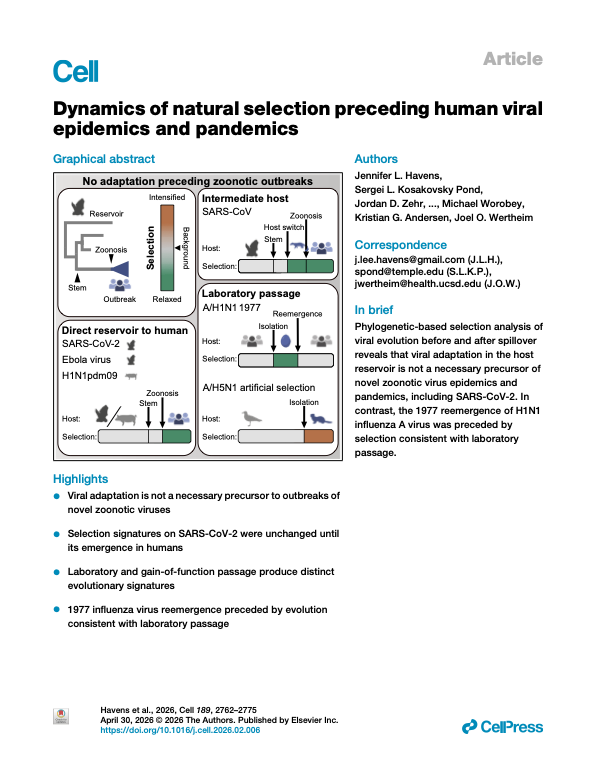
Cell study utilizing HyPhy's RELAX, aBSREL, and MEME models to demonstrate that viral adaptation in host reservoirs is not a prerequisite for epidemics, while identifying clear evolutionary signatures of lab passage.
Uses HyPhy purifying selection tests to explore the survival of multicopy ampliconic fertility genes on the non-recombining human Y chromosome, highlighting gene conversion repair mechanisms.